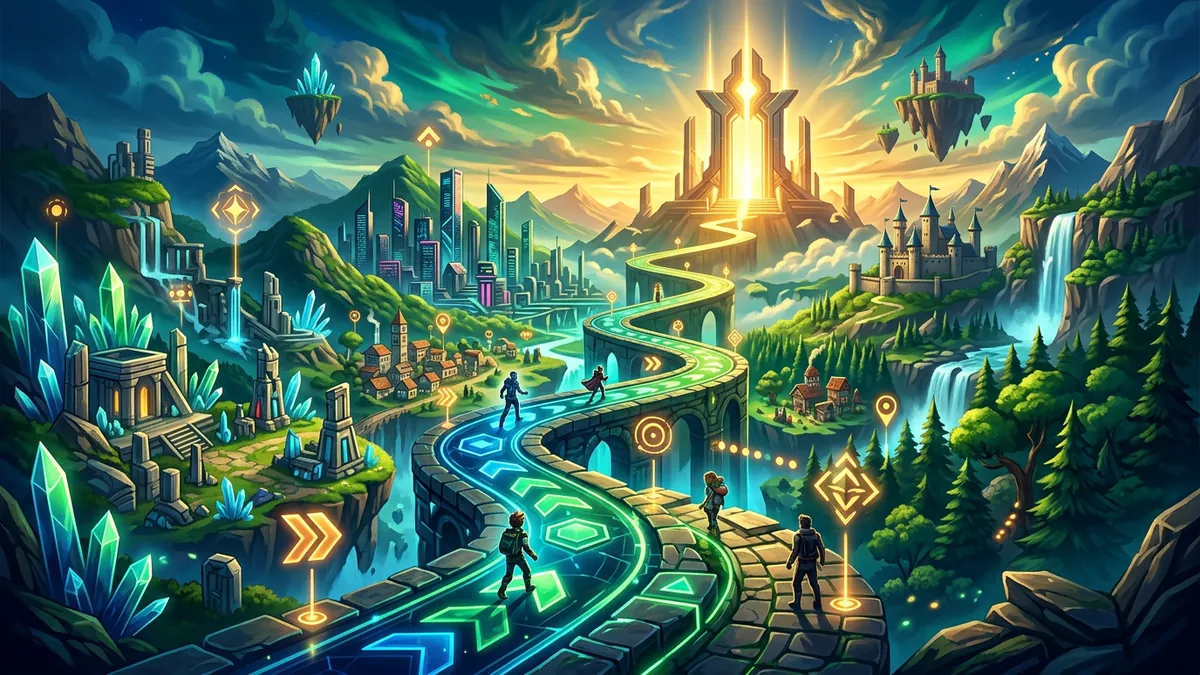
Roblox doesn’t look like the Roblox you remember. Seriously. If the last time you fired up the platform was a couple of years ago, you’re about to have your mind blown. There’s a new generation of experiences on Roblox that are pushing the platform so far beyond what anyone thought was possible that the community has started calling them “4D generation” games — a nod to the idea that these aren’t just next-gen, they’re something entirely new.
We’re talking real-time ray tracing visuals, AI-driven NPCs that actually respond to what you say, physics systems that rival standalone titles, procedurally generated worlds that are different every time you play, and immersive design that makes you forget you’re inside Roblox at all. The gap between “Roblox game” and “professional game studio release” has never been smaller.
I’ve spent the last few weeks diving deep into the most innovative experiences on the platform, and here are the ones you absolutely need to try.
What Makes a Game “4D Generation”?
Before we get into the list, let’s define what we’re actually talking about. A 4D generation Roblox experience typically demonstrates several of these qualities:
- Visuals that push Roblox’s engine to its limits — Custom shaders, advanced lighting, high-poly models, atmospheric effects that rival indie games on Steam
- AI-driven systems — NPCs, enemies, or world elements that use actual artificial intelligence rather than simple scripted behavior
- Complex physics — Real-time physics simulations for destruction, fluid dynamics, soft body physics, or realistic vehicle handling
- Procedural generation — Worlds, levels, or content that generate dynamically so no two play sessions are the same
- Immersive design — Sound design, camera work, UI/UX, and narrative that create a cohesive experience rather than just a game
- Technical innovation — Using Roblox’s tools in ways the developers never intended, or pushing recently released features to their absolute maximum
Not every game on this list hits all of these criteria, but each one is doing something that made me stop and think “wait, this is Roblox?”
The 4D Generation Experiences You Need to Play
1. Ethereal Horizons
Genre: Open World Exploration | Players: 15,000+ concurrent
This is the game that started the 4D generation conversation. Ethereal Horizons is an open-world exploration experience set on a series of floating islands with a day-night cycle, dynamic weather, volumetric clouds, and real-time global illumination that makes every sunset look like a painting. The world is massive — we’re talking hours of exploration without repeating content.
What makes it truly special is the AI companion system. You have a companion character that learns your play style over time. If you explore aggressively, it starts pointing out hidden caves. If you prefer peaceful wandering, it leads you to scenic viewpoints. The AI genuinely adapts, and it’s a little eerie how well it reads you after a few sessions.
The development team spent over two years building this, and it shows in every detail. The ambient sound design alone — distant waterfalls, wind through crystal formations, your footsteps changing on different surfaces — puts most Roblox games to shame.
2. Project Nexus
Genre: Sci-Fi Shooter/RPG | Players: 25,000+ concurrent
Project Nexus is what happens when a team of incredibly talented Roblox developers decides to build Destiny inside Roblox. It’s a sci-fi shooter with RPG elements, procedurally generated dungeons, a loot system with thousands of weapon combinations, and cooperative raids for groups of six.
The gunplay feels incredible. Every weapon has distinct recoil, audio, and visual feedback. The movement system includes sliding, mantling, and wall-running. The enemy AI is dynamic — enemies flank, retreat when injured, call for reinforcements, and adapt to your tactics. If you keep sniping from the same spot, they’ll start sending flankers.
The procedural dungeon system is the crown jewel. Every time you start a run, the layout, enemy placement, environmental hazards, and loot are different. It creates genuine replayability in a way that most Roblox games can’t match.
3. Verdant
Genre: Ecological Simulation | Players: 8,000+ concurrent
Verdant is unlike anything else on Roblox. It’s an ecological simulation where you manage a living ecosystem. You start with a barren landscape and introduce plants, insects, animals, and weather patterns. The simulation runs in real-time — plants grow, animals eat, predators hunt, rivers flow based on actual fluid dynamics, and the entire ecosystem evolves based on your choices.
The physics engine behind the water system alone is staggering. Rain collects into streams, streams form rivers, rivers carve the terrain over time. You can build dams and watch the water level rise behind them. You can introduce a predator species and watch the food chain ripple.
It’s educational, it’s meditative, and it’s technically breathtaking. The fact that all of this runs inside Roblox is genuinely impressive. This is the kind of game that showcases what the platform is capable of when developers push the boundaries.
4. Chronoscape
Genre: Puzzle/Narrative | Players: 10,000+ concurrent
A narrative puzzle game where time manipulation isn’t just a gimmick — it’s the core mechanic implemented at an engine level. You can rewind, fast-forward, and pause time for individual objects in the environment. Freeze a falling boulder mid-air to create a platform. Rewind a destroyed bridge to cross a gap. Speed up a growing vine to reach a ledge.
The visual presentation is stunning. Each time period has a distinct art style and color palette. The transitions between time states are smooth and visually satisfying. The soundtrack shifts dynamically based on what time state you’re.
The puzzle design is the real star. Later chapters combine multiple time states simultaneously — you might need to freeze one object, rewind another, and fast-forward a third, all while navigating a timed platforming section. It’s the kind of game that makes you feel like a genius when you solve a puzzle.
5. Depths Unknown
Genre: Underwater Exploration/Horror | Players: 12,000+ concurrent
An underwater exploration game with horror elements that uses Roblox’s lighting engine to create some of the most atmospheric moments I’ve ever seen on the platform. You pilot a deep-sea submersible into procedurally generated ocean depths, discovering alien marine life, sunken structures, and things that really don’t want you exploring their territory.
The depth mechanic is brilliantly done. As you descend, the light fades gradually, your sonar range decreases, and the creatures become more aggressive and strange. The sound design is world-class — the creaking of your submarine under pressure, the distant calls of unknown creatures, the unsettling silence between encounters.
The procedural generation means every dive is different. You never know what you’ll find. Some dives are peaceful explorations of bioluminescent gardens. Others are tense survival situations where something massive is circling just outside your sonar range. If you enjoyed Subnautica, this captures that same feeling inside Roblox.
6. Architect’s Dream
Genre: Building/Creative | Players: 20,000+ concurrent
Roblox has always been a building platform at its core, and Architect’s Dream takes that concept to the extreme. It’s a building sandbox with physics-enabled structures, real material properties, dynamic lighting you can customize per object, and a structural integrity system that means your buildings have to actually make engineering sense or they’ll collapse.
What sets it apart from other builders is the material simulation. Wood burns, glass shatters, metal bends, stone crumbles. If you build a wooden house and set the fireplace too close to a wall, your house catches fire. If you build a glass bridge and overload it, the glass cracks and shatters. This isn’t scripted — it’s simulated.
The community showcase is incredible. Players have built functioning clocks, Rube Goldberg machines, realistic cityscapes, and structures that respond dynamically to weather. It’s like if Minecraft and a professional architecture tool had a baby.
7. Fauna
Genre: Creature Survival | Players: 18,000+ concurrent
You play as a procedurally generated creature in a world full of other procedurally generated creatures. Your creature’s body plan — legs, wings, eyes, mouth type — determines your abilities and how you interact with the world. A creature with wings can fly but is fragile. A creature with armor plating is tough but slow. A creature with multiple legs is fast on land but can’t swim.
The AI ecosystem is what makes this sing. Other creatures aren’t just obstacles — they have their own needs, territories, and social behaviors. You’ll see herds migrating, predators stalking prey, creatures building nests. You’re part of this living world, not the center of it.
The evolution system lets your creature adapt over time. If you spend time in water, your descendants develop fins. If you hunt at night, they develop better eyes. It’s like Spore reimagined with modern AI and running inside Roblox.
8. Aurora Station
Genre: Space Station Management | Players: 9,000+ concurrent
A space station management sim where you build, maintain, and expand an orbital station while managing crew needs, research projects, and the occasional crisis. The station orbits a beautifully rendered planet with real-time day/night cycles visible through your station windows.
The physics for the station modules are impressive — each module has mass, each connection has structural limits, and if you build your station poorly, modules can decouple during thruster firings. The internal atmosphere system tracks oxygen, temperature, and pressure room by room. A hull breach in one module creates a genuine pressure differential that affects connected rooms.
It’s essentially Oxygen Not Included meets Space Station 13 on Roblox, and it works remarkably well.
9. Gridfall
Genre: City Builder/Strategy | Players: 14,000+ concurrent
A city builder with traffic simulation, economic modeling, and citizen AI that actually simulates individual needs. Each citizen has a home, a job, preferences, and behaviors. They commute, shop, socialize, and react to city conditions. Build near a park and property values go up. Build near a factory and residents complain and leave.
The traffic simulation is the standout feature. Vehicles follow actual pathfinding through your road network, obey traffic signals, and create realistic congestion patterns. If you build a highway off-ramp that feeds into a two-lane road, you’ll get a traffic jam. The game teaches real urban planning principles through gameplay.
10. Whisper Protocol
Genre: Cooperative Stealth | Players: 7,000+ concurrent
A cooperative stealth game for teams of 2-4 players where the AI security system learns from your attempts. Get spotted through a window? Next run, the guards patrol that window more frequently. Keep using the ventilation system? They start checking vents. Use the same entry point twice? Extra cameras appear.
The adaptive AI creates a genuine cat-and-mouse dynamic where you can’t just memorize patterns. Each heist requires actual on-the-fly strategy. Communication with your team is essential, and the game integrates proximity voice chat so you have to whisper when guards are nearby. It’s incredibly tense and incredibly satisfying when a plan comes together.
The Tech That Makes This Possible
These games aren’t happening in a vacuum. Roblox has made significant platform upgrades that enable 4D generation experiences:
| Technology | What It Enables | Launched |
|---|---|---|
| Real-Time Global Illumination | Dynamic lighting that bounces realistically off surfaces | Late 2025 |
| Expanded Memory Limits | Larger, more detailed game worlds with more assets | Early |
| AI Integration APIs | Developers can build AI-driven NPCs and systems | Early |
| Improved Physics Engine | More complex simulations with better performance | 2025 |
| Spatial Audio | 3D sound positioning and environmental audio effects | 2025 |
| Higher Polygon Limits | More detailed character and environment models | Early |
| Procedural Generation Tools | Built-in tools for creating dynamic content |
The convergence of all these upgrades at roughly the same time is what sparked the 4D generation wave. Developers suddenly had access to tools that were simply unavailable a year ago. The most talented creators on the platform took those tools and ran with them.
How 4D Generation Compares to Traditional Roblox
Let’s be honest about the comparison:
| Aspect | Traditional Roblox | 4D Generation |
|---|---|---|
| Visual Quality | Blocky, simple, iconic | Near-indie quality, atmospheric |
| AI Systems | Scripted behavior, simple pathing | Adaptive, learning, emergent |
| Physics | Basic collision, simple gravity | Real-time simulation, destruction |
| World Size | Fixed maps, loaded at start | Procedural, expanding, dynamic |
| Replayability | Content-driven, same each time | Systemic, different each session |
| Accessibility | Runs on anything | Scales, but best on mid-range+ |
| Development Time | Weeks to months | Months to years |
Both types of games will always have a place on Roblox. Simple, accessible games like obbies, tycoons, and simulators aren’t going anywhere — they’re the backbone of the platform. 4D generation experiences represent the ceiling of what’s possible, and they’re pulling that ceiling higher every month.
Games to Watch
A few experiences that are currently in beta or development that could join this list soon:
- Project Aether — An atmospheric flight simulator with real weather patterns and terrain generation
- Symbiosis — A cooperative alien planet survival game with a fully simulated ecosystem
- Glasspoint — A detective game with AI-generated mysteries that are different every time
- Construct — A engineering puzzle game with real structural physics and material science
Final Thoughts
The 4D generation of Roblox games proves something that a lot of people have been saying for years: Roblox is not a kids’ platform. It’s a game engine. And in the hands of talented developers with access to modern tools, it can produce experiences that rival games on any platform.
If you haven’t explored the cutting edge of Roblox lately, start with any game on this list. Ethereal Horizons if you want to be amazed by visuals. Project Nexus if you want gameplay depth. Depths Unknown if you want atmosphere. Fauna if you want something truly unique. Every single one of these experiences is free to try, and every single one will change your perception of what Roblox can be.
The next generation isn’t coming. It’s already here.
FAQ
How often should I revisit this guide?
Re-check this guide weekly, especially after game updates, code resets, or balancing patches.
What should I do if a code or method no longer works?
Verify the latest in-game patch notes first, then test alternatives from official Roblox or developer channels.
Is this strategy beginner-friendly?
Yes. Start with the baseline tips here, then scale into advanced tactics once your account progression is stable.