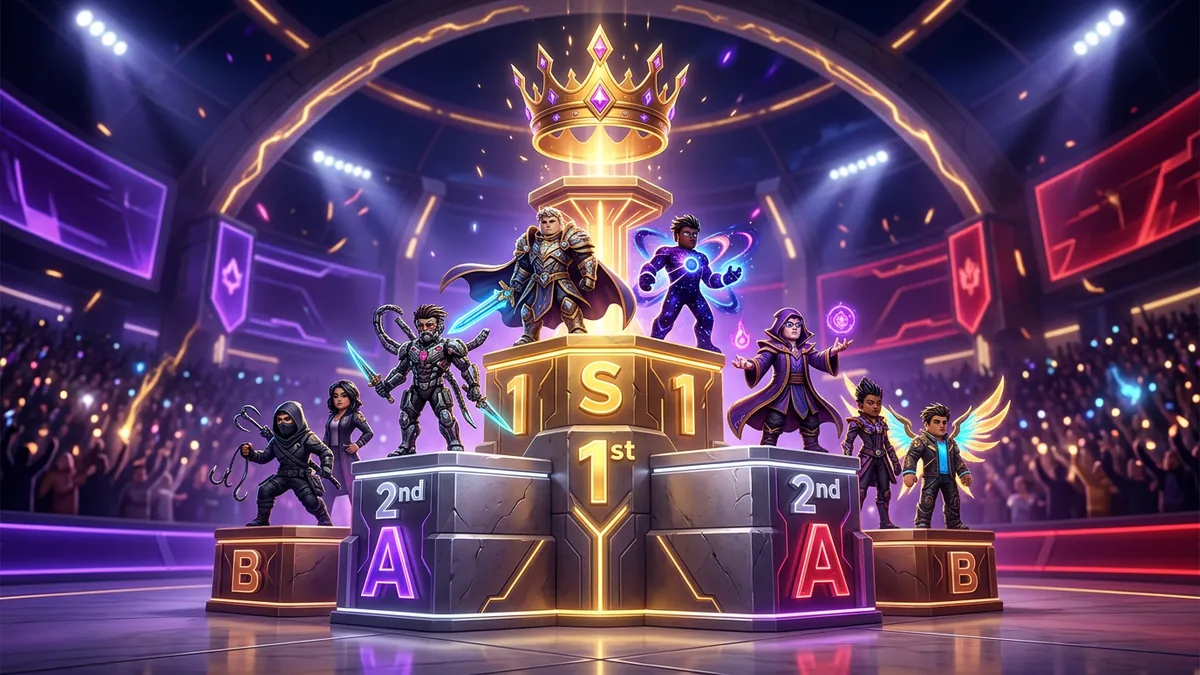

Need the best Roblox Rivals weapons and characters for ranked right now? Start with Burst Rifle, Minigun, Exogun, Katana, Alpha, Blaze, and Viper. The rest of this tier list explains when those picks are actually worth using and which loadouts fall off once the lobby gets stronger.
This page is built for ranked intent first: quick meta winners, then the full explanation for weapons, characters, team comps, and map-dependent picks.
Already know the basics? Check out our Roblox Rivals beginner guide for economy management, map callouts, and movement tech that will level up your gameplay.
Roblox Rivals Tier List – Quick Overview
Here is the full breakdown at a glance. Scroll down for detailed explanations.
Weapon Rankings
| Tier | Primary Weapons | Secondary Weapons | Melee |
|---|---|---|---|
| S | Burst Rifle, Minigun, Shotgun, Sniper | Exogun, Revolver | Katana, Trowel |
| A | Assault Rifle, Bow, Paintball Gun, Permafrost | Sling Shot, Hand Gun | Scythe |
| B | Grenade Launcher, RPG | Uzi | Knife |
| C | Flamethrower | Flare Gun | Fists, Chainsaw |
Character Rankings
| Tier | Characters | Role |
|---|---|---|
| S | Alpha, Blaze, Viper | Damage / Zone Control |
| A | Nova, Phantom, Titan | Flex / Support |
| B | Shade, Ember, Volt | Situational |
| C | – | Avoid in ranked |
The tiers above reflect the current state of the game after the February balance patch. Things can shift fast in Rivals, so keep an eye on update notes every few weeks.
S Tier Weapons – The Meta Picks
S tier weapons are the ones that dominate lobbies right now. If you are not running at least one of these, you are putting yourself at a disadvantage.
Burst Rifle
The Burst Rifle is the single strongest primary in the game right now. Each trigger pull fires three rounds in a tight burst, and landing that full burst on a target chunks nearly 60 percent of their HP. At mid range, nothing competes with it. The burst pattern is predictable enough that good players can consistently land headshots.
The downside is that it punishes missed shots harder than an auto weapon. If you whiff a burst, the recovery time gives your enemy a window to fight back. But if your aim is decent, the Burst Rifle outperforms everything else.
Minigun
The Minigun is pure chaos in the right hands. A 200-round magazine with an absurd fire rate means you can hold angles, suppress entire corridors, and shred through multiple enemies without reloading. In objective modes, parking a Minigun on a choke point is almost unfair.
The catch is mobility. You move significantly slower while firing, which makes you a sitting duck for flanks and sniper shots. The Minigun is S tier because of its raw lethality, but it requires good positioning to actually work.
Shotgun
Close range fights in Rivals come down to one weapon – the Shotgun. All 10 pellets landing on a target deal 75 damage, meaning two clean shots kill anyone. In the tight corridors of maps like Big Station, the Shotgun is nearly unstoppable. Pair it with Blaze and you become an entry fragger who clears sites before the enemy team can react.
Sniper
The Sniper delivers 150 damage on a headshot – an instant kill with zero damage falloff. One click removes a player from the round entirely. Body shots take about three hits to secure a kill, which is slow. But on longer maps, a good sniper player can lock down entire sight lines and force the enemy team to burn utility just to cross open areas.
S Tier Secondaries – Exogun and Revolver
The Exogun is the best secondary weapon in Rivals by a wide margin. Its AOE blast damage lets you hit enemies around corners and behind cover, which is something no other secondary can do. It is genuinely better than some primary weapons and gives you a real option when your primary runs dry mid-fight.
The Revolver hits hard at mid-to-close range and is a reliable swap weapon when you need to finish someone off fast. Two headshots and they are done.
S Tier Melee – Katana and Trowel
The Katana can deflect bullets. That alone makes it S tier. The extended reach also means you can hit enemies before they hit you in melee range. In clutch situations where you have no ammo, the Katana gives you an actual chance to win.
The Trowel lets you build walls while reloading. This is an insanely underrated mechanic. You can create cover on demand, block sight lines, and give yourself time to reload safely. Competitive players are starting to realize how strong this is, and Trowel usage in ranked has climbed steadily.
A Tier Weapons – Strong and Reliable
A tier weapons are not as dominant as S tier, but they are strong enough to win fights consistently and work well in most situations.
Assault Rifle
The Assault Rifle is the default primary for a reason – the most balanced weapon in the game. Decent damage, manageable recoil, good range, and a forgiving fire rate. For beginners, this is the best weapon to learn spray control fundamentals. Veterans still use it as a comfort pick when they want a reliable round.
Permafrost
The Permafrost got a small buff in the Labor of Love update – damage went from 13 to 14 per hit. It fires in two-round bursts with 30 ammo. The reduced damage dropoff ranges (40 studs start, 100 studs end) mean it falls off hard at distance. Run this on close-to-mid range maps only.
Bow and Paintball Gun
The Bow has high damage with solid range but projectile travel time means hitscan weapons beat you in reaction-speed fights. The Paintball Gun is semi-automatic and obscures enemy vision on hit, creating openings for your team in coordinated play.
A Tier Secondaries and Melee
The Sling Shot has a high fire rate and bouncing ammo that works in tight spaces. The Hand Gun is the most reliable secondary across all ranges. The Scythe hits hard as a melee weapon but cannot deflect bullets like the Katana.
B Tier Weapons – Situational Picks
B tier weapons work in specific scenarios but have clear limitations that hold them back from regular use.
Grenade Launcher
The Grenade Launcher sounds good on paper but the grenades are slow, easy to dodge, and the explosion radius is not large enough to punish grouped-up teams consistently. Useful for area denial in objective modes, but a good team will rotate around your grenades.
RPG
Same problems as the Grenade Launcher but worse. Slower projectile, fewer shots before reload. Direct hits deal massive damage, but landing them against moving targets is not realistic against competent players.
Uzi
Decent close-range secondary with a fast fire rate, but falls off outside point-blank range. Best paired with a Sniper as a close-range backup.
Knife
Basic melee option with no special mechanics. No deflect, no building – just raw damage if you can close the distance.
C Tier and Below – Use at Your Own Risk
These weapons have fundamental problems that make them hard to justify in competitive play.
Flamethrower
Damage over time in a cone, but the range is terrible and you have to stay exposed. Any decent player just backs up and shoots you. Fun in casual, hurts your team in ranked.
Flare Gun
Slow projectiles and unreliable damage. The only upside is blocking flank angles with fire zones, which is extremely niche. Almost any other secondary is better.
Fists and Chainsaw
Proximity-based damage with no special mechanics. The Chainsaw sounds intimidating but gets you killed before you reach anyone with a functioning primary. Meme picks, not serious options.
S Tier Characters – The Ranked Dominators
Characters in Rivals are not just cosmetic – their abilities directly impact combat effectiveness. Picking the right character for your playstyle and your team composition matters, especially in ranked.
Alpha
Alpha is the most well-rounded character in the game. High damage output combined with strong survivability means you can play aggressive or defensive depending on the situation. Even if you make a mistake, you have tools to recover. Alpha works with every weapon loadout and every team composition – there is no situation where picking Alpha is a bad choice.
Blaze
Blaze is built for aggression. Fast cooldowns combined with burst damage potential means you overwhelm opponents before they can react. Pair Blaze with a Shotgun or Burst Rifle and push into sites at full speed. The downside is that Blaze struggles when you need to play slow, but on attack rounds, Blaze is the best entry character in the game.
Viper
Viper is the strategic brain of Rivals. The ability kit revolves around zoning and choke point control – cut off entire sections of the map and force enemies into unfavorable paths. Viper requires more map knowledge than Alpha or Blaze, but once you learn a map, Viper controls it. On maps with tight corridors like Chess, Viper is nearly broken.
A and B Tier Characters – Solid to Situational
Nova (A Tier)
Nova is the jack-of-all-trades character. Balanced performance in solo and team play makes Nova flexible enough for any situation. Easy to learn but difficult to master. If you are not sure what character to play, Nova is always a safe pick.
Phantom (A Tier)
Phantom’s kit revolves around stealth and mobility. Flanking abilities let you appear where enemies do not expect you. Phantom rewards unpredictable play – creative players who switch up their approach every round can carry games. But if the enemy reads your routes, Phantom’s strengths disappear.
Titan (A Tier)
Titan is the frontline tank. High durability means you soak damage while your team deals it. Paired with Blaze, Titan creates space for pushes. The limitation is that Titan relies on teammates for damage, making solo queue weaker.
Shade (B Tier)
Unpredictable abilities that catch enemies off guard in lower ranks. But experienced players know the counterplay, making Shade a liability in higher ranks.
Ember (B Tier)
Solid damage but lower survivability. The hit-and-run playstyle works against uncoordinated teams but falls apart when enemies communicate and collapse on you.
Volt (B Tier)
Excellent mobility for chasing weakened enemies and repositioning. But limited power means Volt works best in a support role, cleaning up kills. Volt does not win a fair 1v1 against any S-tier character.
Best Team Compositions
Team composition matters more in Rivals than most Roblox PvP games because the round-based format and economy system reward coordinated strategies over individual plays.
The Balanced Comp (Best for Ranked)
Alpha (flex) + Blaze (entry) + Viper (controller) + Titan (anchor) + Nova (support). This covers every situation – entry power, zone control, durability, and flexibility. No glaring weakness.
The Rush Comp (Aggressive)
Blaze + Phantom + Alpha + Volt + flex pick. Everyone pushes together, overwhelms one site, wins through speed. Weak to teams that rotate quickly and play defensive setups.
The Fortress Comp (Defensive)
Viper + Titan + Alpha + Nova + Shade. Lock down a position and force the enemy to come to you. Strong on defense rounds but struggles when you need to attack.
If you want to see how these characters fit into broader builds, check our PvP builds guide for loadout theory across multiple Roblox games.
How the March Update Changed the Meta
The February Labor of Love update dropped several balance changes that are still shaping the March meta. Here is what shifted and why it matters.
Weapon Balance Shifts
Permafrost went from 13 damage to 14 per hit, but the damage dropoff ranges got reduced from 50 to 40 studs (start) and 125 to 100 studs (end). This is a net buff at close range but a nerf at distance. Permafrost moved from a borderline B/A tier weapon to a solid A tier pick on smaller maps.
Haul got its equip cooldown reduced from 1.7 seconds to 1.25 seconds, but damage dropped from 50 to 40. The faster swap makes it more viable as a combo weapon, but the damage nerf hurts its standalone value.
Hitscan weapons received broad nerfs because they were dominating at all ranges. This is why the Burst Rifle (which has a slight projectile delay) moved up relative to pure hitscan options.
New Maps
Big Station and Chess were added with the Labor of Love update. Big Station has tight corridors that buff Shotgun and Blaze. Chess is more open with longer sight lines that favor Snipers and Viper’s zone control.
What to Watch For
The development team patches roughly every 3 to 4 weeks. Expect another balance pass soon, potentially addressing the Minigun’s dominance in lower ranks and the Burst Rifle’s consistency at mid range.
Tips for Climbing Ranks
Knowing the tier list is only half the battle. Here is how to actually use this knowledge to gain rank points.
Master Two or Three Weapons
Do not try to learn everything at once. Pick one S tier primary, one A tier backup, and learn them deeply. Know the spray patterns, the effective ranges, the reload timings. A player who has mastered the Assault Rifle will beat a player who randomly switches between S tier weapons every round.
Economy Management Wins Games
The biggest mistake in ranked is buying every single round. Sometimes you need to save (eco round) so you can afford a full buy with armor and utility the next round. Learn the economy breakpoints: how much you earn from a loss streak, how much a full buy costs, and when to force-buy versus save.
Play Your Character’s Strengths
If you pick Blaze, play aggressive. If you pick Viper, play for zone control. The worst thing you can do is pick a character designed for one playstyle and then play the opposite way. Blaze sitting in a corner waiting for enemies wastes the entire kit.
Use Utility, Do Not Hoard It
Your abilities have cooldowns, not limited charges per game. Use them. Zone off angles with Viper, push aggressively with Blaze abilities, scan with support utility. Hoarding abilities for a clutch moment that might never come wastes value every round.
Warm Up Before Ranked
Play two or three deathmatch games before jumping into ranked. Get your aim warm and shake off rust. This is the easiest way to gain more rank points and most players skip it. Also optimize your FPS – even small performance gains matter in reaction-speed fights.
Watch Your Own Replays
Rivals lets you review past matches. Watch your deaths and ask what you could have done differently. Were you out of position? Did you peek when you should have held? Self-review is how good players become great players.
More Tier Lists
- Anime Knockout Tier List - Best characters for the top anime PvP game on Roblox
- BedWars Tier List - Best kits and strategies ranked
- Forsaken Tier List - Killers and survivors ranked for the horror meta
FAQ
What is the best weapon in Roblox Rivals right now? The Burst Rifle is the best weapon as of. Its three-round burst chunks nearly 60 percent of an enemy’s HP. The Assault Rifle is a close second for full-auto consistency.
Is the Minigun overpowered in Roblox Rivals? It is extremely strong but slows your movement speed significantly. Good players will flank you. It dominates low-rank lobbies but gets harder to use at higher ranks.
Which character is best for beginners in Roblox Rivals? Alpha and Nova. Alpha has high damage plus strong survivability, so you can make mistakes and recover. Nova is easy to learn with balanced solo and team performance.
How does the economy system work in Roblox Rivals? You earn credits from kills, round wins, and objectives. You spend credits during the buy phase on weapons, armor, and utility. Force-buying every round leaves you broke when it matters.
What is the best loadout in Roblox Rivals? Burst Rifle primary, Exogun secondary for AOE damage, Katana melee for bullet deflection. Pair with Blaze for aggression or Viper for zone control.
Is Roblox Rivals like CS2 or Valorant? Yes. It has an economy system, buy rounds, objective-based gameplay, and no respawns during rounds. The main differences are Roblox-specific mechanics, character abilities, and a more accessible skill floor.
How often does the Roblox Rivals meta change? Every 3 to 4 weeks with major updates. The Labor of Love update changed several weapon stats. A weapon that is S tier one month can drop to B tier after a single nerf.
What is the best melee weapon in Roblox Rivals? The Katana can deflect bullets and has extended reach. The Trowel is a close second because it lets you build walls while reloading for instant cover.
Does character choice matter in Roblox Rivals ranked? Yes. Alpha and Blaze dominate ranked because of their damage and survivability. Viper is essential for zone control on certain maps. Playing a C-tier character against an S-tier at equal skill is a real disadvantage.
What sensitivity should I use for Roblox Rivals? Between 0.10 and 0.15 for consistent aiming. Lower sensitivity gives better precision for headshots and spray control. Start at 0.12 and adjust from there.
More Roblox Tier Lists and Guides
This tier list will be updated when the next major Rivals patch drops. Bookmark this page and check back after each update to stay ahead of the meta. For all our rankings across every Roblox game, check out the full tier lists hub.
If you want more Roblox competitive content, check out our Anime Knockout tier list for another top PvP game, or read the full Roblox Rivals beginner guide for deep dives on economy management, map callouts, and movement tech.